
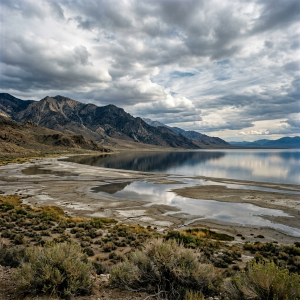
Drive down US-95 along the edge of Walker Lake and you’ll reach Hawthorne, a quiet town with one of the most unusual histories in the American West. Its story isn’t about a gold rush that fizzled. It’s about a railroad, a deadly explosion, and a war.
A Town Platted by a Railroad
Hawthorne began as a railroad company’s project. The Carson & Colorado Railroad was incorporated in May 1880, and rails reached Hawthorne on April 7, 1881, with facilities built there as a division headquarters (Nevada Expeditions). Railroad officials laid out the town in the desert and auctioned the first lots on April 14, 1881 (Nevada SHPO). The name came from the railroad’s Henry Yerington, who named the town after a lumberman, rancher, and law enforcement friend, William Hawthorne (Wikipedia).
Growth was slow. No mines of significant value turned up nearby, and the town got a small boost only in 1883, when the Esmeralda County seat moved from Aurora. The railroad carried the town through the 19th century, and it had 436 residents in 1900 (AHGP).
Bypassed by the Railroad, and the County Seat Shuffle
The railroad’s fortunes shifted in the early 1900s. When the line was converted to standard gauge in 1905, the rails were realigned through Thorne and Dover, bypassing Hawthorne (Nevada Expeditions). The seat of government moved too: Goldfield took the county seat in 1907, but Hawthorne regained it when Mineral County was created in 1911 (Nevada SHPO).
Lightning in New Jersey
Hawthorne’s defining event happened 2,500 miles away. On July 10, 1926, lightning struck a Navy ammunition warehouse at Lake Denmark, New Jersey, and started a fire (Wikipedia). The blast and fires raged for days, heavily damaged the nearby Picatinny Army Arsenal and surrounding communities, killed 21 people, and seriously injured more than 50 (AP via JEMS).
Following the court of inquiry’s recommendation, construction of the Hawthorne Naval Ammunition Depot began in July 1928 on a 327-square-mile area of Nevada. It opened in September 1930 and received its first shipment of high explosives on October 19 (Wikipedia). A Navy history of the period notes that the old depots were overloaded with leftover World War I explosives, which made safe dispersal an urgent problem (Building the Navy’s Bases).
A War Boom
World War II transformed the town. Before 1944, Hawthorne had never topped 1,000 residents and often had only a few hundred (Nevada Magazine). During the war the depot supplied ammunition, bombs, and rockets to West Coast ports for the Pacific theater (FortWiki). One regional report puts the wartime population at 13,000, falling to roughly 1,000 to 2,000 after the war (UNR Extension).
The depot kept growing and served as an important ammunition center in the Korean and Vietnam Wars (Army.mil). Its administration kept changing hands: the Army took it over in 1977 as the Hawthorne Army Ammunition Plant, it became contractor-operated in 1980, and it was renamed Hawthorne Army Depot in 1994 (FortWiki). Today it stores reserve ammunition meant for use after the first 30 days of a major conflict (Wikipedia).
The Lake, and the People Who Were Here First
The land has a far older story. The Northern Paiute people who lived here called Walker Lake Agai Ticatta, or Trout Lake (Mineral County Museum). Jedediah Smith passed near the lake in 1828, Peter Skene Ogden in 1829, and John C. Frémont in 1845 with his guide Joseph Walker, for whom the lake is named (Nevada SHPO).
The lake itself has declined sharply. As early as 1885, the USGS noted that irrigation diversions were dropping the lake’s level (Wikipedia). By USGS estimates, the surface has fallen about 150 feet since 1882, while dissolved solids rose from 2,500 to 16,000 milligrams per liter (USGS). Hawthorne’s boom-and-bust history is tied to water as much as to ammunition.
Sources
- Nevada Expeditions: Carson & Colorado Railroad
- Nevada SHPO, Marker 237 and Marker 16
- American History and Genealogy Project: Mineral County
- Hawthorne Army Depot (Wikipedia) and FortWiki
- Building the Navy’s Bases in World War II
- AP via JEMS and Army.mil
- Nevada Magazine: True Grit, Hawthorne and UNR Extension
- USGS Walker Lake bathymetry report and Mineral County Museum
Leave a Reply