
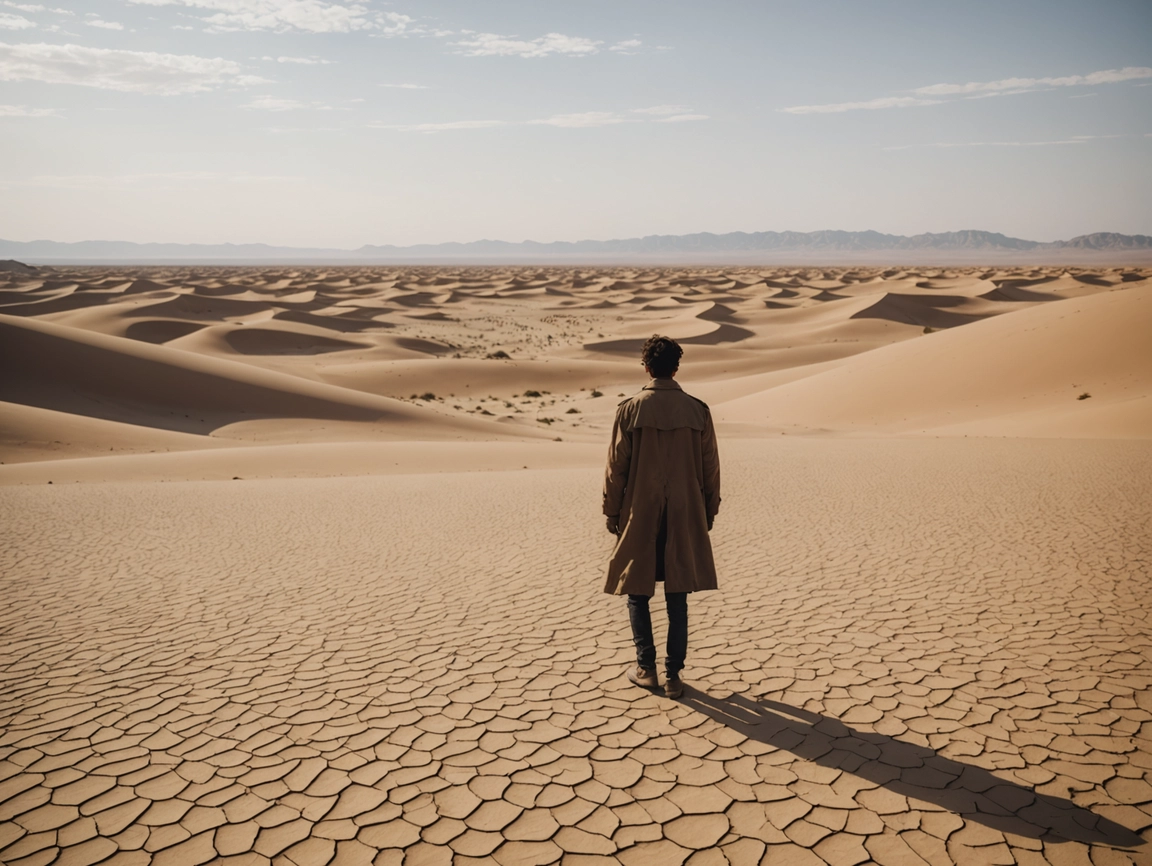
Years ago, I came across a phrase that stayed with me: “Stalled Dreams in a Vacant Parking Lot.” It feels like the perfect description of the last decade of my life, the years I’ve spent feeling stranded in Hawthorne. I think I’m slowly learning how to live here, but for a long time it felt like being marooned.
The thing about stalled dreams is that they aren’t necessarily dead. They can be restarted, rerouted, or rebuilt. That belief has carried me through these years. I’ve tried to see this chapter not as a final failure, but as a detour — a season of waiting for a new beginning. Even a derailed train can be lifted back onto its tracks with enough time and effort. I’m hoping this is the year that finally happens. I can’t bear the thought of wasting away any longer in a community that feels like it’s fading.
What I still struggle with is defining the dream I want to reclaim. It’s hard to choose a direction when every horizon looks like endless sand. When I try to spark hope, it feels like strong winds put it out. There’s little warmth in a barren desert, and little relief beneath a relentless sun. Some places, like certain corners of the mind, were never meant to be inhabited for long.
The landscape here mirrors that feeling. Walker Lake sits nearby — a lake that has been dying for decades, even as the community resists acknowledging it. Instead of adapting and seeking new relevance, there’s a tendency to pour money into battles that cannot truly be won without costing others their prosperity. In many ways, stalled dreams and quiet hopelessness feel woven into the identity of Hawthorne itself.
My time here has ultimately been an act of love. I was happy in Colorado. I had a comfortable townhome in a growing city, a solid career, and close friends. But my husband was deeply unhappy with the direction of his career. When he found an opportunity here, I encouraged him to take it — even though something in me hesitated.
Since arriving, fulfillment has been hard to find. I worked on the base twice; both experiences were deeply discouraging. I worked for the school system, and the stress nearly broke me. I later took a job at a treatment center and found it just as troubling as the broader environment around it. Professionally, nothing here has truly aligned with who I am.
One lesson I’ve learned is that change is not inevitable. In isolated places, stagnation can become a way of life. Sometimes things don’t improve because no one is willing to let them. There can be a fierce attachment to the past, even as the present slips away. Small symbols are celebrated as progress while meaningful opportunities are pushed aside to preserve what remains of yesterday.
I’ve also learned that chasing status in a small, insular world is hollow. Competing for validation in a limited arena eventually reveals how little it matters. Happiness isn’t determined by the approval of people whose perspectives rarely extend beyond their immediate surroundings.
I’ve seen how small-town egos can swell in the absence of wider context. People who might be unremarkable elsewhere can be elevated simply by longevity. In a place where growth is rare, stagnation can be mistaken for stability, and familiarity for merit.
Not all my dreams evaporated in the desert heat. I became a foster parent to a child I never would have met otherwise. If my life hadn’t felt so empty in other ways, our paths might never have crossed. He wasn’t a bad kid — just one who had been overlooked for years. He needed someone to believe in him, and I’m grateful I could be that person.
Despite everything, I’m still holding onto the belief that stalled does not mean finished. I’m still searching for the dream worth restoring — and for the courage to build a life that feels alive again.I refuse to accept that a down of stagnation and despair can permanently hold me back. I just need to out maneuver the past and find myself a future, despite the constraints.
